Remote Shepherd
An observation-based puzzle game built around realistic ballistics and emergent crowd behavior
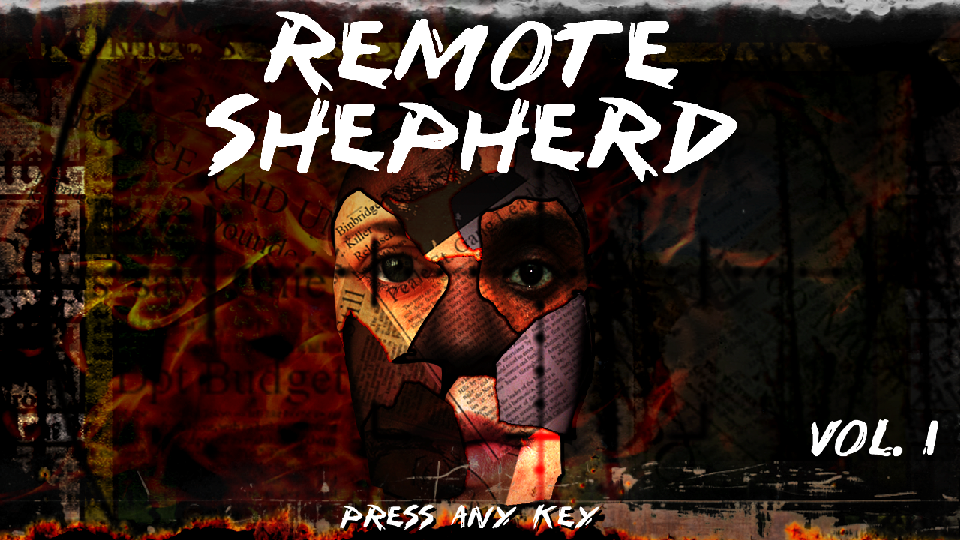
Remote Shepherd is a simulation-driven sniper and puzzle game built in C# using a proprietary engine. The project focused on combining realistic ballistics, AI-driven NPC behavior, and emergent crowd systems to create levels that function as interactive puzzles.
Rather than fast-paced action, the game emphasizes observation and systems understanding. Players complete objectives by analyzing behavior, manipulating the environment, and choosing when and how to act.
Key Features
Observation-driven, puzzle-based gameplay focused on timing and decision-making
Realistic ballistics with travel time and projectile drop
Up to 60 AI-driven NPCs active simultaneously
Emergent crowd behavior driven by “contagious” emotional states
Multiple valid solutions per level based on player interaction with systems
Comic book-inspired visual style
Roles and Responsibilities
Led AI design and implementation, including NPC behavior systems and crowd dynamics
Directed visual style and overall art direction
Created 2D visual assets and UI elements
Assisted with 3D rigging and animation
Designed and implemented sound effects and audio elements
Crowd System
The crowd system was built as a layered system combining individual AI, crowd-level behavior, and a dynamic animation system. Rather than treating each character in isolation, simple behaviors and attributes were allowed to propagate between NPCs, producing emergent group behavior.
Individual AI
Each NPC was driven by a behavior tree, with finite state machines used in specific cases where tighter control over transitions was needed. This hybrid approach allowed for flexible high-level behavior while maintaining predictable responses in key situations.
NPCs could wander, rest, jog, and perform contextual tasks such as buying or selling items, and would react dynamically under certain conditions by fleeing or panicking. Their behavior was influenced both by internal goals and by the surrounding environment, including the actions of nearby NPCs.
This combination of individual goals and environmental influence helped create characters that felt responsive and believable, while still supporting the larger crowd system.
Crowd AI
Remote Shepherd is centered on observing groups of people, so the crowd system needed to feel both believable and interesting to watch over time. Rather than treating NPCs as isolated agents, emotions and behaviors were modeled as transmissible conditions that could spread between nearby characters. This “contagious” model allowed the crowd to behave as more than a collection of individuals, producing complex, emergent group behavior.
The system was inspired by epidemiology models and borrows concepts such as transmission thresholds, susceptibility, and contagiousness. In Remote Shepherd, the primary transmissible state was fear. When an NPC reached a sufficient level of fear, their behavior changed and they became “contagious,” influencing nearby characters and potentially triggering cascading reactions through the crowd.
This allowed players to observe and anticipate crowd reactions, turning group behavior into a readable and interactive system rather than background activity.
Dynamic Animation System
Because the player would spend the majority of their time observing crowds, the expression layer needed to be as engaging as the underlying mechanics. I developed the State-subState-Set Animation Engine to introduce controlled variation in how characters expressed their AI states.
The system combined state-based animation logic with probabilistic variation. High-level behaviors were driven by finite state machines, while animation selection within those states used weighted randomness inspired by Markov chains. This allowed characters in the same state to behave slightly differently over time, avoiding repetition while still maintaining readable, consistent behavior.
Together, these systems allowed simple rules to combine into complex, emergent behavior across large crowds.
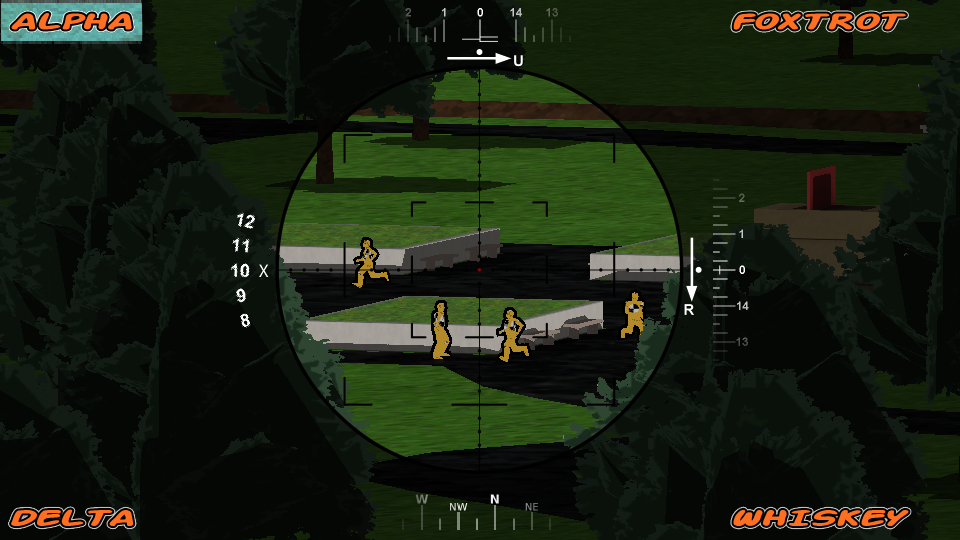
Panicked NPCs beginning to flee in Training Mode.
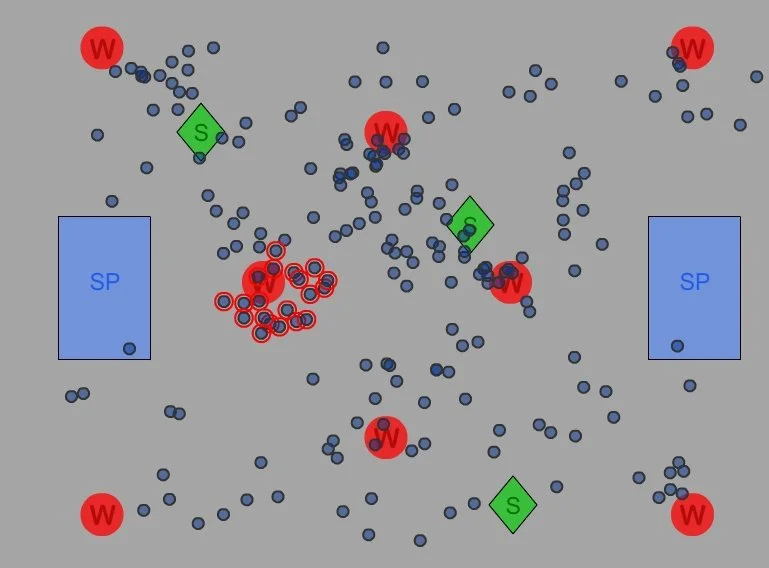
Early proof-of-concept of the “contagious” behavior system, illustrating how information spreads through a population and forms emergent clusters based on proximity and movement patterns.
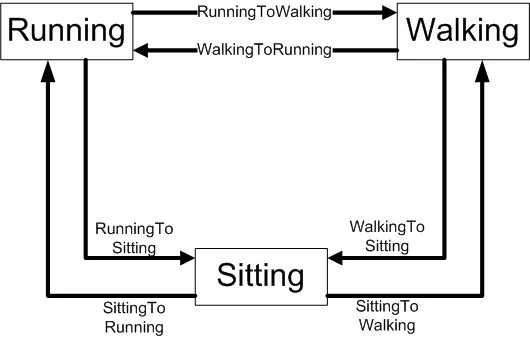
Example Animation State Machine
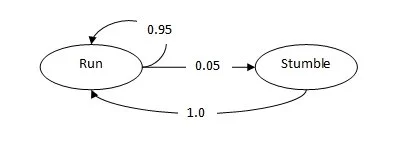
Example Animation Sequence Graph
Design and Player Experience
Remote Shepherd emphasizes observation and understanding over reflexes. Rather than reacting quickly, players succeed by studying systems and recognizing patterns and anomalies in behavior.
Observation
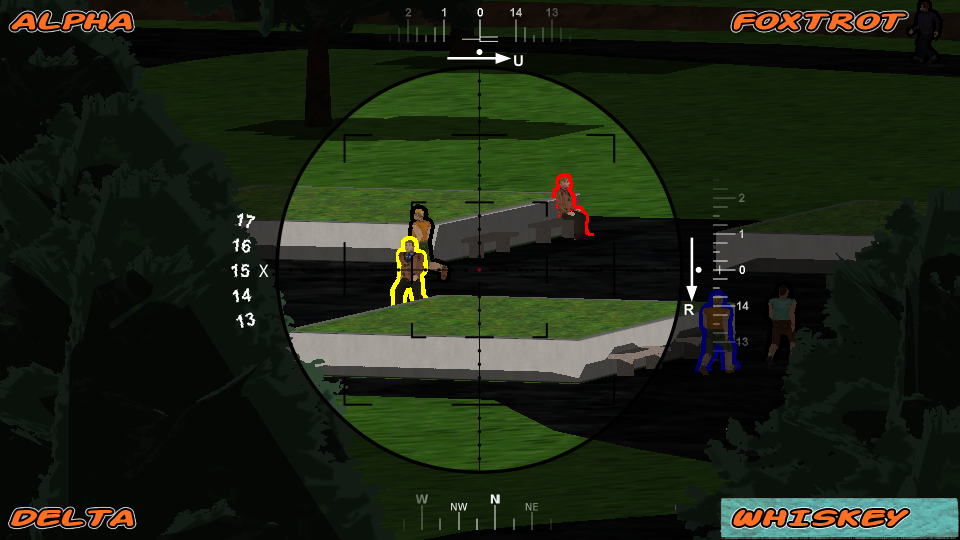
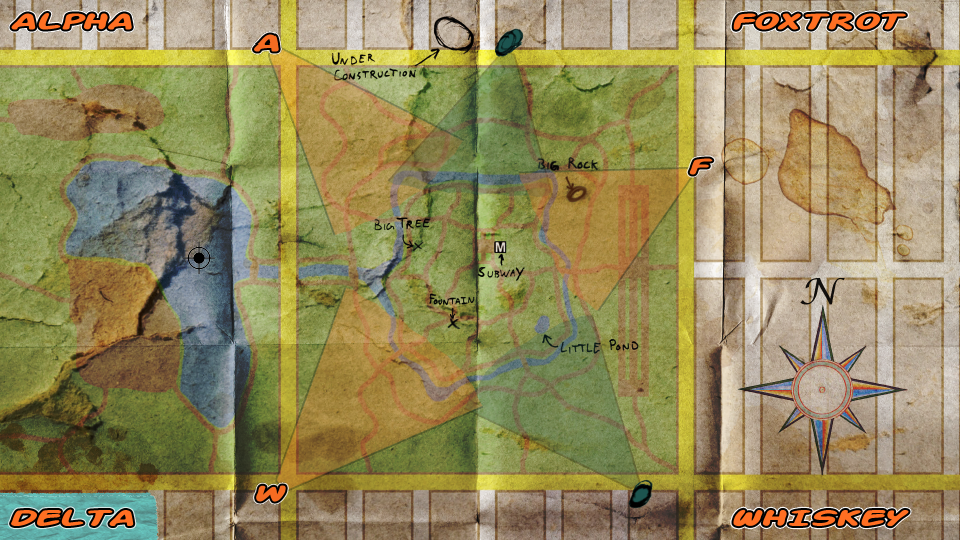
The player assumes control of a team of three snipers, each equipped with a rifle, a directional microphone, and a telephoto camera. They can reposition each sniper around the map and switch between their perspectives to gain multiple vantage points.
Information is gathered through both visual and audio cues: visual details are observed through the rifle scope or camera lens, while the directional microphone allows the player to isolate and track sound.
Puzzles can be resolved using either the rifle or the camera, with each approach leading to different outcomes.
Systems as Puzzle
Remote Shepherd was designed around the idea of locating a specific individual in a crowd without knowing their appearance, relying instead on behavioral cues. The core puzzle is identifying who is behaving anomalously within a crowd of otherwise patterned behavior.
This shifts the focus from reacting to events to interpreting behavior. Players are not given explicit objectives or visual markers; instead, they must observe how individuals move, interact, and respond to their environment.
Most characters follow predictable patterns like walking routes, idle behaviors, or simple interactions, creating a baseline of “normal” behavior. The challenge is recognizing when someone deviates from those patterns in subtle ways, such as moving with purpose, reacting differently to nearby events, or avoiding expected interactions.
Solving the puzzle becomes a process of forming and testing hypotheses. Players observe the crowd, identify potential anomalies, and decide when and how to act, using either the rifle or the camera. Because the systems are dynamic, the “correct” solution is not fixed, and outcomes depend on timing, interpretation, and player choice.
Challenges and Problems Solved
Some behaviors were better suited to finite state machines, while others were more naturally expressed using behavior trees. To support both approaches, I implemented a custom behavior tree node that encapsulated a finite state machine, allowing the two models to work together within a single system.
Pathfinding across complex navigation graphs can lead to uneven NPC distribution. To evaluate this, I partnered with another team member to develop a heatmap system based on NPC presence. This allowed us to identify underutilized paths and make targeted adjustments to the environment, resulting in a more balanced and believable “crowded park” atmosphere.
Realistic ballistics and meaningful in-game consequences created a need for a training mode where players could experiment without penalty. However, this raised concerns about tone and whether such a mode could feel inappropriate given the subject matter.
The solution was to preserve the underlying physics and AI behavior while shifting the visual presentation away from realism. NPCs were retextured to resemble crash-test dummies, maintaining mechanical accuracy while reducing the real-world implications of player actions.
Visual Design and UI
The visual design of Remote Shepherd was guided by three goals: establishing a distinctive style, creating an appropriate tone, and ensuring that complex systems remained readable.
Without careful consideration of tone, the subject matter could easily veer into poor taste. To address this, the game adopts a comic book–inspired visual style. This illustrative approach — along with the decision to exclude graphic elements such as blood — creates distance from realism, shifting the focus away from real-world violence and toward mechanics and narrative. The visual direction draws inspiration from sources ranging from classic Marvel comics to the work of collage artist Dave McKean.
In addition to shaping tone, the stylized aesthetic also supports readability. Bright, contrasting colors and strong outlines help distinguish characters and behaviors within the crowd, making it easier for the player to interpret what is happening at a glance.
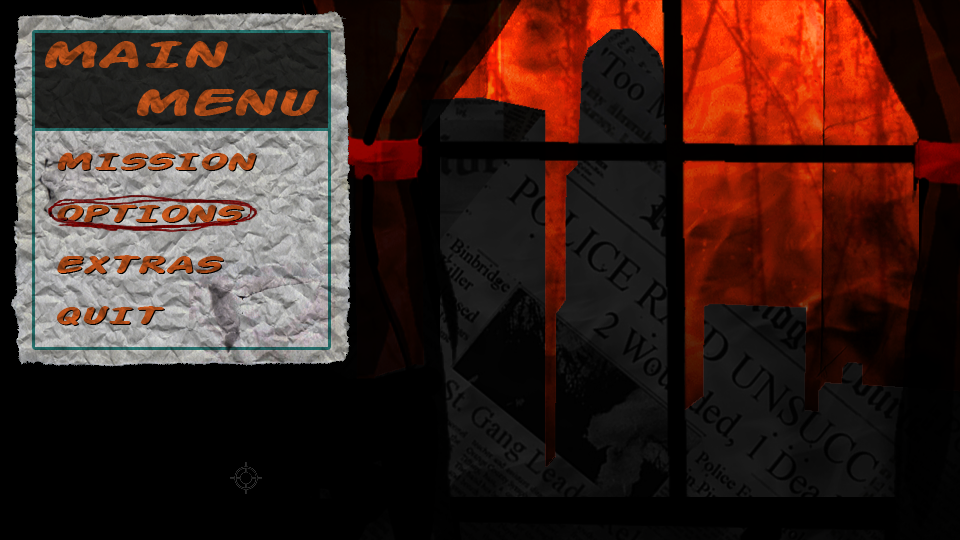
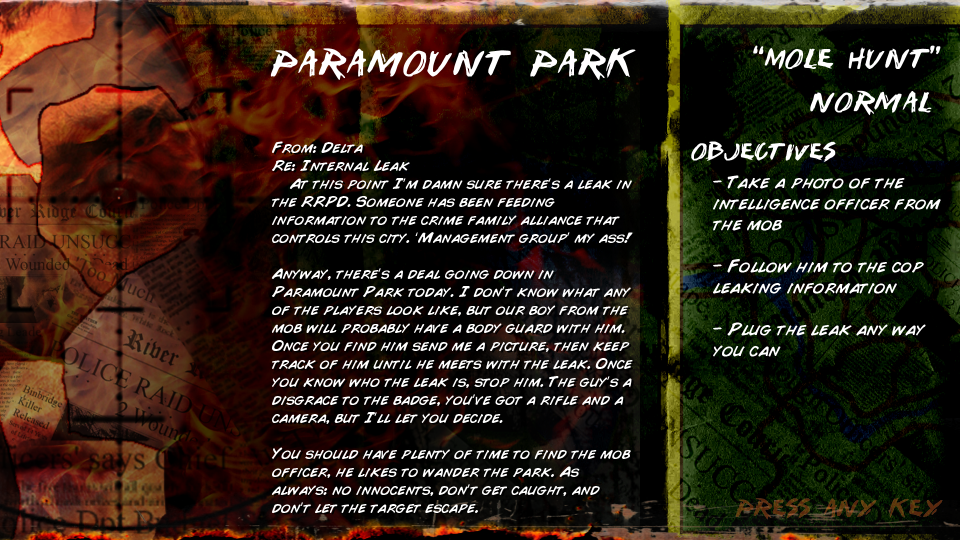
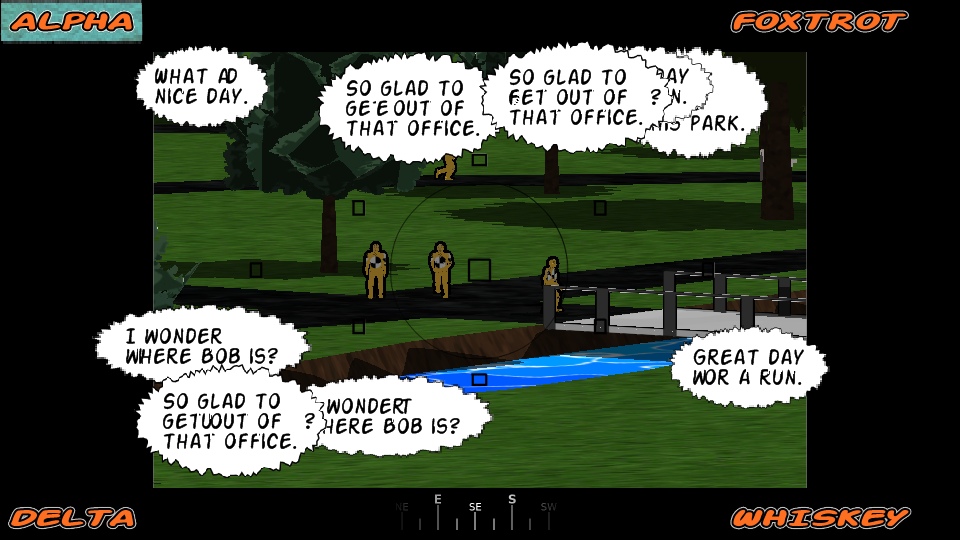
Word bubbles replace voice acting, reinforcing the comic book aesthetic. Jumbled or incomplete text represents aural noise captured through the directional microphone.